
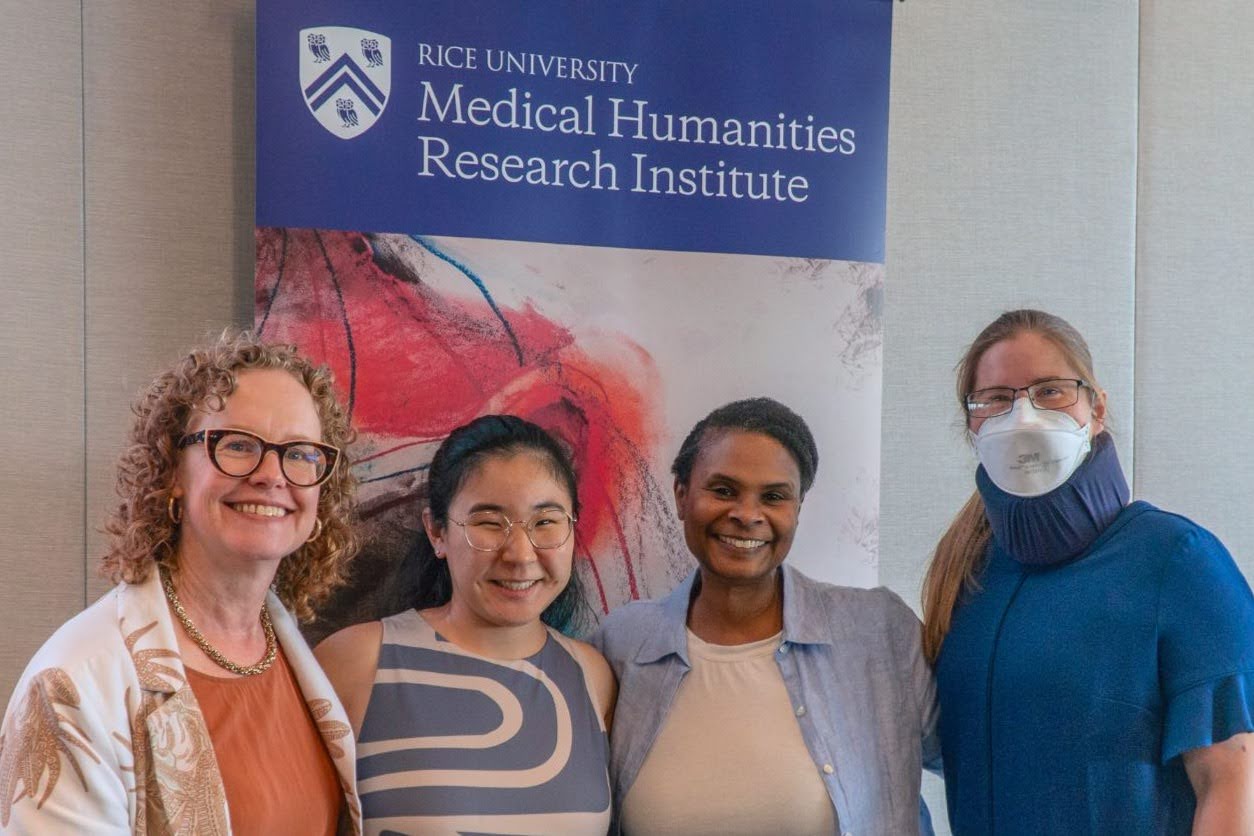
Pictured from left to right: Kirsten Ostherr (Rice), Momona Yamagami (Rice), Kim Gallon (Brown University), and Dana Lewis (OpenAPS, patient advocate)
Photo by Conner Schultz
The Sawyer Seminar series that MHRI has hosted through an award from the Andrew W. Mellon Foundation concluded April 14 with “Reimagining Technologies of Care,” a final panel discussion with guest speakers Dana Lewis (OpenAPS, patient advocate), Kim Gallon (Brown University), and Momona Yamagami (Rice University). The panel discussion focused on technology’s ever-growing influence on user experiences of medical care and strategies to improve patient experiences through technological methods.
Dana Lewis, a patient advocate and digital health hacker, is the creator of OpenAPS (Open Artificial Pancreas System Project), which aims to make artificial pancreas technology widely available to people with type I diabetes. Her lived experience with diabetes inspired her to take immediate action instead of waiting for extensive regulatory and administrative processes. During the panel, Lewis shared how patients can be leaders in innovation through community-driven research like OpenAPS. She encouraged students to be intentional about their role in innovation and questioning existing systems.
Kim Gallon, associate professor of Africana Studies at Brown University, specializes in Black Studies, History, Digital and Health Humanities, and Health Informatics. Her work involves reimagining AI to improve health outcomes for Black communities, who have historically been subjected to structural racism resulting in health disparities. While AI systems often perpetuate these biases, Gallon is exploring ways to alter the technology to better represent Black communities. One possible solution is training models on a broad spectrum of information, including Black press archives and literature, medical journals, and personal narratives.
Rice University’s Momona Yamagami is assistant professor in Electrical and Computer Engineering and a member of the Rice Digital Health Initiative and Houston Methodist-Rice Digital Health Institute. Yamagami’s research focuses on creating personalized human-machine interfaces that support health and accessibility. She emphasized the importance of humanities perspectives in engineering, stating, “the people who are often in the room making decisions about engineering choices [...] are not necessarily the people who will be using the technology.” She hopes that engineering may move towards a future where diverse perspectives are incorporated into design processes and solutions.
The Rice University Sawyer Seminar “Reimagining Technologies of Care: Racial Health Equity and Data Justice” is sponsored by the Andrew W. Mellon Foundation. For more information on the Andrew W. Mellon Foundation Sawyer Seminars, visit this website. Additional support comes from the Rice Building Research on Inequality and Diversity to Grow Equity (BRIDGE) Program, Rice Scientia Small Conference Fund, the Baylor College of Medicine Office of Community Engagement and Health Equity, the Dan L. Duncan Cancer Center Office of Community Outreach and Engagement, and the UTHealth Houston McGovern Center for Humanities and Ethics.