
Interview with Elizabeth Reis, PhD
(Professor Emerita, University of Oregon)
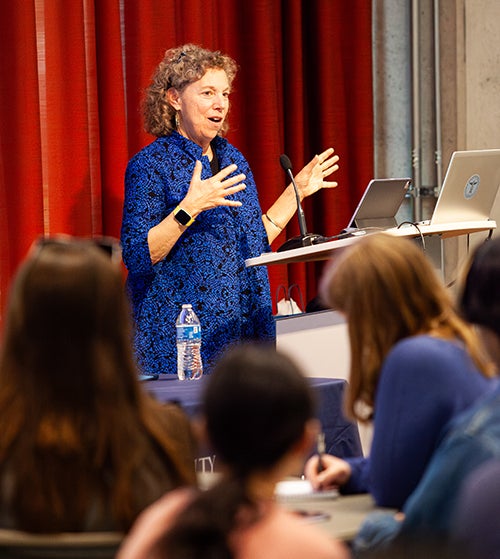
Intersex through the lens of physicians
In the medical humanities, there's a strong emphasis on the patient narrative, centering the story on people who are actually affected by the illness. But in your talk today, you mentioned that these historical records that you are reviewing were primarily authored by physicians. When you were analyzing these historical journals for your new book, did you find any traces of the patients’ own voices or perspectives? Or is the history of intersex issues almost entirely filtered through the lens of those physicians?
That's a really good question,and you're right that now we really do focus on patient-centered care. But in the past, that was not the case. And especially with this issue, surprisingly, doctors really felt that they knew better than the patients themselves what gender the patient should be. Which is something so intimate and personal, that it really struck me that the doctors would feel that they knew best.
But until fairly recently, the last 20 years or less, people who were born with intersex traits were not writing memoirs or even responding in a way that a historian would ever be able to read. Sadly, when I was looking at this, everything was filtered through the doctors. Not only doctors, but only the doctors who thought that their case was interesting enough to publish about, and could get it published. But because I knew I didn't have the intersex voices themselves, one of the things I was really looking for when I read these accounts was that patient voice. Often, doctors were offering people surgeries to “fix” what they felt was “wrong” with them. For listeners, I'm putting all those things in air quotes because there was often no reason to “fix” anything, and there was nothing wrong with the person. These were just natural variations that people were born with. But the doctors had different things in mind. So I was looking very intently for the patient voices.
Sometimes I saw things where I just had to content myself that this was kind of the patient voice. For instance, a doctor would say to somebody, “You've been living as a woman for 34 years, but I really think that you're a man. I would suggest this surgery, which will lengthen your urethra. Hopefully you'll be able to stand to urinate.” The person objected to that and wanted to go on living as a woman. The doctor would write, sometimes very simply, that the patient stubbornly refused. So I know from that that the patient refused and that I was happy to see that there was some agency on the part of adults and that they didn't have to cave in to what the doctor suggested. The doctor might have thought they were stubborn. Patients might have thought they were within their full rights, not stubborn at all. I don't know how patients felt, because all I have is what the doctor wrote. Sometimes the doctor was even more aggressive in his analysis of a patient who wouldn't go by “him.” There's one case that I mentioned in today's talk where the doctor says that the patient was stupid and didn't have enough courage to endure the surgery which would put them in the opposite gender.
Some people might have wanted to switch genders, but a lot didn't. Even though I don't have what I would love to have, which is a patient diary from the 1920s, I'm sure it's out there, somewhere in someone's attic, but I didn't have access to it. Maybe in the future, some more of these things will emerge. But what we do have now that somebody who was doing this work, maybe 50 years ago wouldn't have had is that there have been intersex people who have written memoirs about their life and about their experience, about what happened to them as children, about how they feel as adults. And they're wonderful.
When I listen to you talk, it seems like there was a relinquishing of power in this patient-provider relationship. Whether voluntary or involuntary, I'm sure you can speak to it better, but what do you think really spurred this change? Was it the technology and the internet being available that allowed intersex patients to share their experiences? Were they encouraged at all by the medical institution?
No, I don't think they were encouraged to at all. The fact that intersex advocacy has grown so much since the 1990s is really remarkable. One of the starting points was a small group of people in California who got together, who all shared different intersex traits. There's a video of this called “Hermaphrodites Speak.” I can't remember how many were in this group, let’s say eight. There's a microphone, and they videotaped each person taking the microphone and talking about what happened to them as children. It's such a powerful and intense video because it's not scripted. They're just sitting around in their t-shirts and shorts talking about what happened to them. Some are crying, and some are angry, but all of them are just so happy that there are other people who had a similar experience because doctors often made parents feel that they were the only ones that this had ever happened to. There was such an emphasis on keeping it a secret, as if it were something shameful. People who endured the kind of non-consensual medical intervention knew not to talk about this as they got older because their families hadn't talked about it often. There was just this sense of, “better not talk about it.” When you have that, I can only imagine the relief that some people must have felt like, “Oh my God, this happened to you. This happened to you. I'm not the only person.” I’m sure the internet had a lot to do with this by granting the ability to connect with other people and to form support groups. Things just blossomed from there. Also, preceding LGBT advocacy and more emphasis on people's autonomy when thinking about issues having to do with gender and sexuality created a cultural context for intersex advocacy to flourish.
Personally, being born in 2004 and being on Instagram all the time, a lot of these issues are so much more visible now than I can ever imagine that they would have been in the ‘90s or even early 2000s.
Yes! There's a book called Middlesex (Jeffrey Eugenides, 2002), a novel that was an Oprah pick in 2007.That book featured an intersex character. My book was first published in 2009. When I was working on this from the early 2000s and people would ask me what I'm working on, I would say, “have you read Middlesex?” And they said “yes,” because everybody read it because it was an Oprah pick. I would say, “I'm working on that.” And that's what people knew about intersex. This is why the press wanted a second edition. Now there's just so much more out there and people have heard about intersex, not just as a thing that happens, but as an important ethical issue in terms of patient autonomy and who gets to have a say about their body. Should we be doing things to children who are only babies, who really don't have a say over their bodies? Their parents do, but they don't. Babies have no way of knowing their gender and sexuality. That has become more salient in today's world than it was 30 years ago.
Legislation and vulnerable groups
On that topic of children, we see a lot said about trans children when it comes to gender and sexuality issues, especially in regards to legislation. We are in Texas right now. Even nationally, we are seeing a wave of anti-trans laws that ban gender affirming care on the claimed basis that these surgeries are harmful mutilations. Yet, and you mentioned this in your talk today, a lot of these laws include explicit exemptions allowing for these same surgeries on intersex children. It's usually an addendum or something snuck in there. I was hoping that you could talk a little bit more about the history of these exemptions, this double standard, and if you see a path towards legislation that consistently protects both vulnerable groups.
That would be ideal to have a path that protects both vulnerable groups and even sees intersex and trans kids as a vulnerable group. That would be a major step forward because we do not see that with these legislations. There is this exception where they'll say, the same surgeries and hormones that trans kids are seeking, they can't have this, but intersex kids can have this. Doctors shouldn't even be offering this to intersex kids, because in my opinion, it is a human rights violation for them to be having these kinds of medical interventions on very young children. When they get older, they need to have a say and have some meaningful participation in how they want their bodies to look and function, as trans kids are trying to do. Most of the bills have these exemptions, including the national one that just came forward, H.R. 3492, Protecting Children's Innocence Act. Kind of ironic, that title, because it doesn't really protect intersex kids. If you make an exemption that says these kinds of medical interventions are not good for this group, but fine for this group because they want to make “normal boys and girls” when a child is born with an intersex trait and they see this as something that's abnormal, that needs to be “fixed,” it really does undermine all the advocacy that intersex activists have been doing to try and get physicians to leave intersex kids alone. Do not try to “fix” them. There's nothing that needs to be “fixed,” it's a natural variation, unless there is some actual thing that needs to be fixed like to make someone able to go to the bathroom. That has to be fixed, obviously. There might also be some hormonal intervention that a child might need for certain conditions. But that doesn't mean they need to have their genitals made into something that looks more “normal” because that leads to all sorts of harm. I think it is a human rights violation to interfere in a way that's really for a social reason as opposed to an actual medical reason.
In terms of the history of these bans, they are so recent that I don't even know if we can say that there's a history yet, because it's all happening in the last 10 years. As a historian, anything that happens in the last ten years doesn't really seem like history. I don't think any of these legislators know anything about intersex. They see that another state did it, so they're going to throw it in there too, but I think if they actually knew anything about the harm that has been done to intersex kids and what is actually going on, maybe they wouldn't put it in there. A lot of them have probably never even heard of intersex.
It feels like copying off each other's work. It’s interesting to see who does and doesn't get afforded bodily autonomy and at what level. You can make an argument that some of this is almost cosmetic surgery, right? Mandated cosmetic surgery… even just that term is so bizarre.
It really is. I’ve given talks about this history to audiences of physicians. Sometimes they respond by saying, “ Well, these surgeries are much better now. We do them differently. What happened to these people 50 years ago doesn't happen in the same way.” I would like them to get to a point where they say, “We do these differently, but they're still bad.” In my mind, no matter how good they get, these surgeries should not be done until that child's gender and sense of themselves as a sexual being emerges on its own. Without this outside medical intervention, maybe they won't want any surgery at all. Maybe they're happy with their bodily difference. There's nothing wrong with bodily difference. I’m not saying that intersex is a disability, but an important message from disability activists across the last generation is that bodily difference is okay. I would like doctors to come to a point, and parents too, where they realize that they can raise kids with difference. In the past, doctors have said to some parents that their kids will be made fun of, but that's not necessarily true. It's also not necessarily true that having any surgery will make other kids not make fun of them. They might still get made fun of, maybe even more so, because they have to spend all this time in the hospital getting the surgery. So, some of what doctors have said to convince parents that surgery is necessary is just based on assumptions about raising these children and about how they're going to feel.
We always try to look back and think we were so barbaric back then, and we're so much more civilized now. Right now, I'm looking into the history of psychosurgery, and 50 years ago, we were saying the same thing about the lobotomy as a surgical intervention, trying to be very enlightened about it. Who's to say that in 50 years, we won't look back at the surgical aspect of the whole issue and say, “I can't believe we were doing it like that back then.” We have to be really careful when we start talking about how surgery is just so much more advanced now. We're always making progress; it always feels like we know what's best right now.
That makes a lot of sense, and maybe in another 50 years we will look back on this and say, “Can you believe what we used to do to these intersex children?,” especially as more people do write their memoirs and are the subject of films like “The Secret of Me” (Grace Hughes-Hallett, 2025). There's another film that's really good (Every Body, Julie Cohen, 2023). It features three intersex people, one of whom is from Texas, Alicia Roth Weigel. She has also written a really good memoir about her experience (Inverse Cowgirl: A Memoir – A Funny, Vital Account of Intersex Identity, Activism, and Reclaiming Bodily Autonomy, 2023). As more and more people write about or do some kind of thing on Instagram or TikTok or make a whole film, more and more people are going to hear about, recognize what's happened to these children, and say that there's really no reason for it. Maybe we won't have to wait 50 years, is what I'm getting at as more people feel comfortable talking about the things that happened to them. One of the unfortunate parts about this is that it does have to do with bodies and gender and sexuality. For many people, this is very personal and private, and because of the whole history of how the medical intervention has gone, with doctors telling the parents to keep it all secret, there is this whole element of shame around it. I think it takes a brave person to say, “This is what happened to me,” and just put it out there for everybody to see. But, we're also in the internet age, where people have the ability to put it out there in ways that they didn't before. You don't have to get a whole book published. You can just put it on TikTok. If the political climate also changed in a better way, more people might be encouraged to do this, but it might be scary at this time to put stuff out there when there's so many random people commenting back in a negative way. It’s scary, especially when you're sharing something so vulnerable about yourself.
Surgical consent
What I see as the argument on the other side, whether in a medical or legislative context, is the idea of regret, the idea that the state or the medical institution should intervene to stop children from making irreversible changes to their own body. But it seems like, especially in the documentaries that you're referencing and that you showed today in your talk, there's a lot of regret on the other side. There's significant documented testimony and I suspect it is only going to be more in the next few decades, from intersex adults themselves who are expressing profound regret over the non-consensual surgeries that they underwent as children. Why do you think that regret was so frequently ignored? Do you think it just wasn't very public 20 years ago, and now it's going to become increasingly hard to ignore?
Regret is a very interesting topic. People regret knee surgeries, but we don't stop doing knee surgeries because of that. You tell people about the consequences and give them all the information, then let people make their own adult decisions based on true informed consent. Taking a look at the regret statistics for trans surgeries, there seems to be very little regret. I'm talking about very high levels of satisfaction after surgeries in adults. Intersex people had no choice in what happened to them. They regret what happened to them and it makes sense that they would regret it because they had no input in it whatsoever. Sometimes their parents also regret what happened to them. Fifty years ago, yes, but even today, it's very hard for a parent to go against what the doctor is saying, because in the U.S., we think that doctors may not be quite gods, but they're up there. Everybody wants to be a doctor and we want our doctor to know everything and to tell us what to do or at least provide suggestions. So when a doctor says to a parent, your baby's going to be much better off if we intervene in this way surgically, it's very difficult for a parent to say, “well, no, I don't really want to do that,” even in today’s day and age. But there are some parents who are reading online and see that this is a controversial topic. They can see all these intersex memoirs and TV documentaries. I know families where the doctor suggested A, B and C, and the parents are saying, “we're going to wait and we're going to raise our child the best that we can. We don't want to have regret, and we don't want our child to regret what happened to them. If it's not a medical necessity, we're just not going to do it.”
All this emphasis on legislation to ban this or that is one strategy, and another strategy might just be education. I wish there wasn't just one little topic on this in medical school instead of a whole unit. Parents should know about it when they are in a birthing class. I can remember going to a birthing class where you learn about the process and what you’re going to go through before the baby’s born. This was never mentioned. You think you're going to have a boy or a girl that's going to be uncomplicated and easy. But parents should know that this is something that might happen so that they don't have to feel like they need to make a decision on the spot. It's generally not a medical emergency, although it's been made to feel like a social emergency.
It's just like regret from a different perspective. People are worried that a trans child might regret a decision, or even a trans adult might regret a decision that they make about their body, but they're not even giving the intersex kids a chance. They're doing something to them before they are old enough to have any say in it whatsoever, or have any sense of themselves.
It stands to reason that many would regret what happened to them, because they do have ongoing harms like scar tissue, sterilization, incontinence, perhaps picking the wrong gender, ongoing surgeries, ongoing need for hormonal intervention. There's so many sequela that happen after these interventions. It's not just a one-time thing that you never think about again. You think about it for the rest of your life.
As you mentioned in your talk, maybe banning these surgeries up until a certain age, whether that's 6 or 12, maybe that's not the solution. To some degree, I think it is, like you mentioned, a manufactured sort of emergency. We don't teach about it, and then the child is born, and then immediately something needs to be done. It's an emergency. Everyone's hysterical about it. How much is the institution set up for that to happen by not providing that education to patients or providers?
That's a really good point. When I was working on the first edition of my book around 2007, a friend of a friend had a baby that was born with various intersex traits. My friend said to these people, “You should call her. She'll tell you what's going on.” The first thing I said to the family was, “Is the baby healthy?” And the dad said, “Yeah.” I said, “Then you can take the baby home from the hospital and worry about this later.” I was afraid that they would start to get pressure like, “Oh, my God, the baby's born with this, this and this. We have to fix it, let's set a surgical date.” “So the baby is healthy.” You do not have to do anything.” By the time they went to a different doctor in a bigger city, they were so armed with information that the physicians even said to them, “Wow, you know the most that I've ever seen a family know when facing these decisions.” They said, “Yeah, because we've read all about this.”
*This interview has been edited for length and clarity.
photo credit: Andrew Lin