
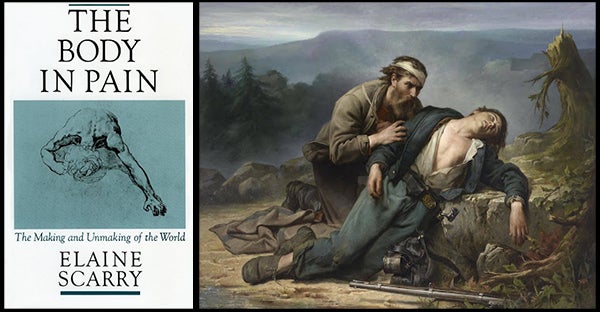
Image sources, from left to right: Cover image of The Body in Pain: The Making and Unmaking of the World, by Elaine Scarry, Oxford University Press, 1985. Front cover. Constant Mayer, Public domain, via Wikimedia Commons

On a sunny spring afternoon, you may be able to spot a cluster of college students trekking towards the museum on a shaded gravel path. This journey is a regular part of the “Medicine and the Museum: Clinical Aesthetics and the Museum of Fine Arts, Houston” course, an engaged learning seminar that extends the learning space beyond the classroom walls and into the city. In the middle of a hectic week of lectures, assignments, and exams, “Medicine and the Museum” is my respite: a time dedicated to quiet observation, deep reflection, and thoughtful engagement with my peers.
The course is taught by Dr. Marcia Brennan, Professor of Religion and Art History at Rice and Artist-in-Residence at UT MD Anderson Cancer Center. She is also the Literary Artist at the Hospital of the University of Pennsylvania. Dr. Brennan shares with students the wisdom and insights gained through years of experience in art history education and end-of-life care.
Each week’s class centers on a different salient theme relevant not only to medicine but also to our shared human experiences. Assigned readings provide theoretical frameworks and background on the topic, while art pieces at the MFAH serve as a vehicle for deeper analysis and discussion.
A typical session starts in the classroom, with Dr. Brennan delivering a short lecture on the history of the art and themes. Then the group dives into a discussion of the week’s assigned reading. It’s a roundtable format– everybody contributes to the discussion as Dr. Brennan moderates, often prompting students to contemplate how their own experiences shape their relationship with the topic.
In the museum, students gather in front of an artwork, reflecting on the differences between viewing it on a PowerPoint slide and observing it in person. One by one, each student shares something that caught their attention: shadows, colors, compositions, or symbols.
For example, during a week focusing on war, trauma, and pain, an excerpt from the classic Elaine Scarry text “The Body in Pain: The Making and Unmaking of the World” is paired with a Constant Mayer painting titled Recognition: North and South. Elaine Scarry’s discussion of pain and its isolating effects complements Recognition’s depiction of a battlefield reunion between a wounded Confederate soldier and his deceased Union brother.
While standing in front of Recognition: North and South, one student might notice that Constant Mayer used less saturated yellow tones to depict the pallor of death on the young man’s face. Someone else refers back to the discussion of The Body in Pain, positing that art is a uniquely suited medium for expressing physical pain, especially given pain’s resistance to language. Another student may connect the image and the feelings it evokes to their own experience of witnessing death for the first time.
During discussions, I am struck by the level of reflection and vulnerability that each student brings to the table. It’s exciting to watch ideas bounce around the table and build off of each other. It’s possible to see the moment that one student’s statement sparks a new thought in another student. Two people looking at the same artwork can have entirely different understandings of the themes, emotion, and story of the piece. A classmate’s interpretation invariably alters my own perspective on the work. It’s almost like I’m seeing through somebody else’s eyes, and it feels like a gift.
Many of my classmates and I are premedical students– aspiring physicians. For us, the museum provides a unique opportunity to practice the soft skills that are invaluable in clinical caregiving, yet often underdeveloped: visual observation, tolerance for ambiguity, seeing from multiple perspectives, and intuitive empathy.
Despite the course’s focus on medicine, the skills of communication and reflection also benefit students from other disciplines, including engineering, art history, and computer science. Each student leaves the course better equipped to interpret ambiguous stimuli, handle ethical dilemmas, and deeply empathize with others.
As Mia Baumann ’26 shares, “Any piece of art can be analyzed from a medical perspective because both art and medicine are uniquely human experiences. Even paintings like still lifes and landscapes can reveal tensions between excess and scarcity, or between vitality and decay. We were challenged to think across multiple dimensions and examine medicine as a social, emotional, physical, and spiritual practice.”
“Medicine and the Museum” is offered as a spring semester course. In the fall semester, Marcia Brennan teaches the medical humanities elective “The Colors of Life and the End of Life” (MDHM/RELI 142) and “Epiphanies” (RELI 375/ HART 328). For more information about Medicine and the Museum, see Brennan’s Case Study about the course.