
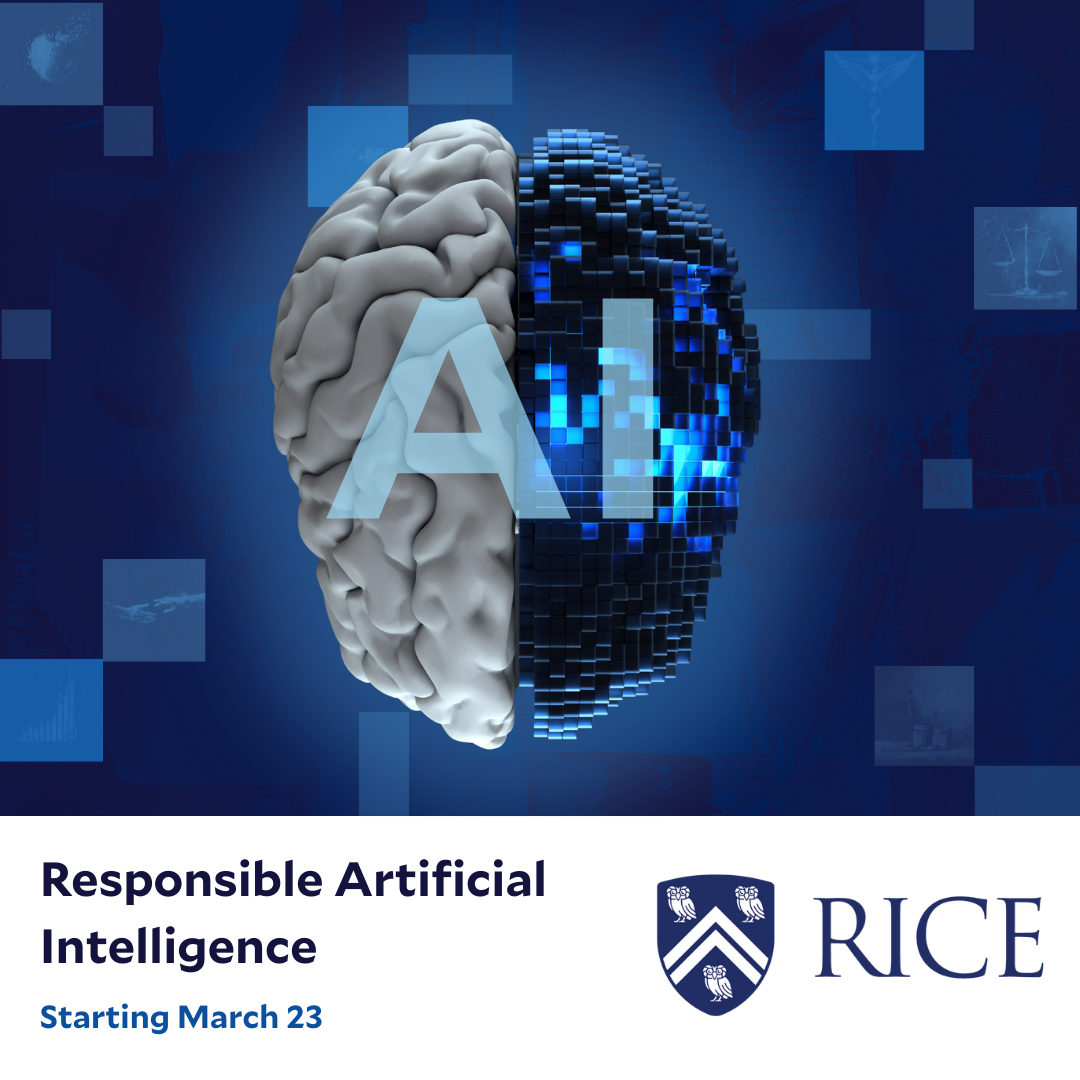
Artificial intelligence is reshaping our world faster than the speed of contemplation, conversation, and imagination. Every industry, from healthcare to logistics, has been revolutionized by the rapid advent of AI technologies. As such, Rice University’s Susanne M. Glasscock School of Continuing Studies will be offering a course this Spring aimed at exploring how to engage with AI responsibly, confronting its risks while harnessing its potential for good.
“Responsible Artificial Intelligence” seeks to provide insight into the social, economic, and psychological costs of AI, not just computational ones. Rice faculty from across the fields of philosophy, engineering, history, and the humanities will lead discussions that ask how these technologies can be ethically implemented into workflows, workplaces, and the greater workforce.
From Dr. Howell and Dr. Gubka’s philosophical inquiries into how machines influence our virtues and emotional labor, to Dr. Petrick’s critical historical analysis of technology and disenfranchisement, we will tackle the tough questions about our future with groundbreaking AI innovations. Simultaneously, we will gain insight into applications of AI on campus, with insights from Dr. Baraniuk and university leadership on how machine learning enhances the Rice experience.
Notably for our MHRI community, our Director, Dr. Kirsten Ostherr, will lead the session on Responsible AI for Health. Dr. Ostherr will examine the humanistic aspects of health AI and address how AI tools should be used to respect and highlight patient narratives and avoid reproducing or even mitigating health disparities. Further details about the class and the topic/speaker list are available below.
March 23. Responsible Generative AI: Harnessing AI for Personal and Societal Good. Robert Howell, Ph.D, Rice University (Yasser El-Sayed Professor of Philosophy Department Chair)
March 30. Leadership in Responsible AI: The Rice University Model. Raza Dawood, M.A., Associate Vice President of Transformational Technology and Innovation, Rice University and Shawn Miller, M.A., Associate Provost for Digital Learning and Strategy, Rice University
April 6. The History, Hype, Hope, and Hazards of Agentic AI. Elizabeth Petrick, Ph.D. Associate Professor of History, Rice University
April 13. Responsible AI for Health. Kirsten Ostherr, Ph.D., Gladys Louise Fox Professor of English, Director, Medical Humanities Program, Director, Medical Humanities Research Institute, Rice University
April 20. Outsourcing Human Emotions and Relationships to AI. Steven Gubka, Ph.D., Postdoctoral Associate, Rice Humanities Research Center
April 27. Responsible AI for Education. Richard Baraniuk, Ph.D., C. Sidney Burrus Professor of Electrical and Computer Engineering, professor of statistics, professor of computer science, Rice University
We invite you to join this essential conversation and help shape a future where technology serves the public good. For more information, visit the Responsible Artificial Intelligence course page.
A limited number of scholarships are available for the course Responsible Artificial Intelligence with generous funding from a Rice Digital Learning and Strategy Accelerating Responsible AI for Education grant. The deadline to apply for a scholarship is February 1. Please visit the scholarships page for more information.
Note: This is not a technical class, and no experience is required for this accessible course, which consists primarily of lecture and discussion. If you are unfamiliar with Generative AI, you may also be interested in the online workshop, Generative AI Primer, taught by Raza Dawood.