
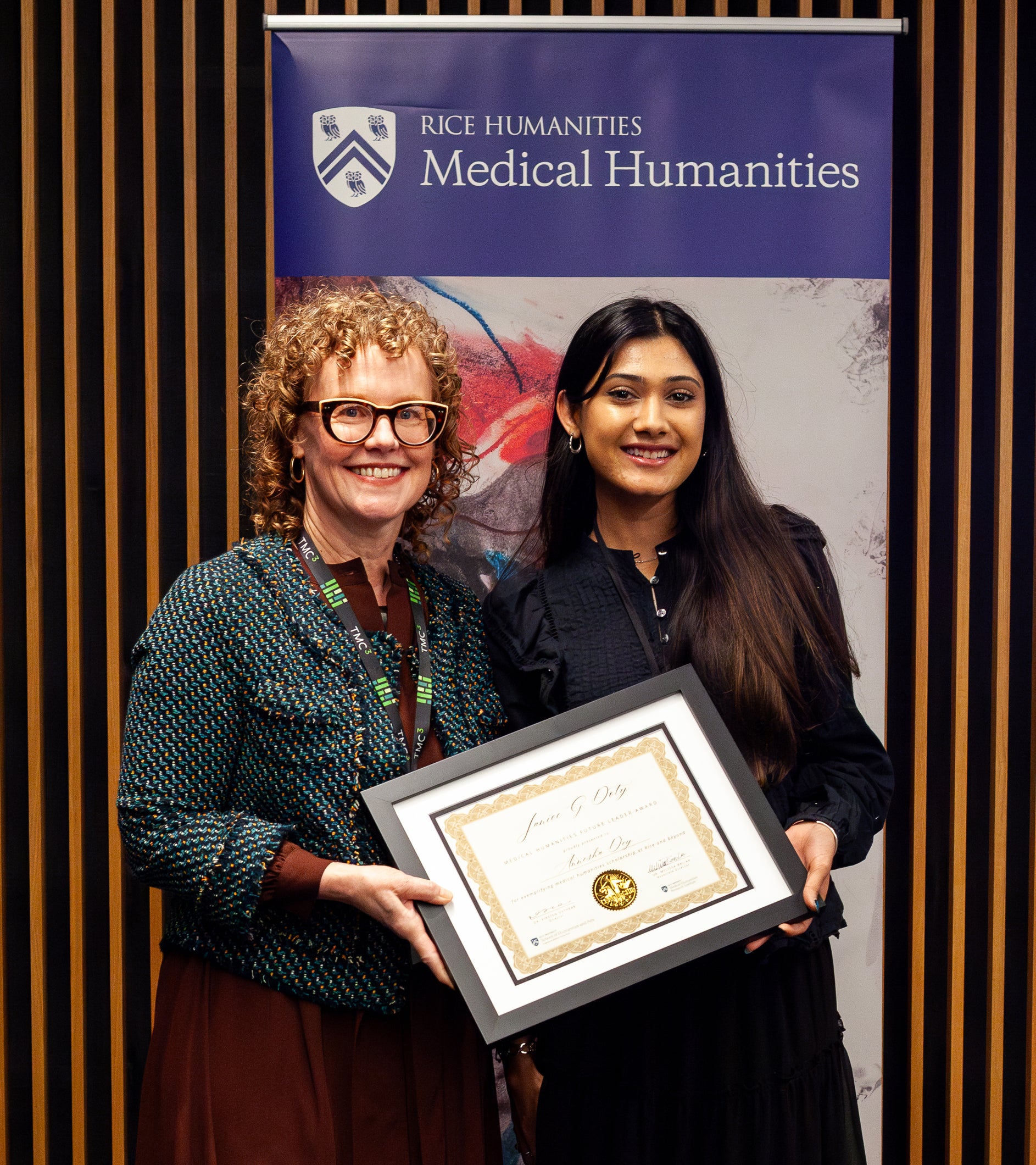
Photo by Andrew Lin
The Medical Humanities Research Institute is proud to announce Annesha Dey as the inaugural recipient of the Janice G. Doty Medical Humanities Future Leader Award. The award, named in honor of distinguished Rice alumna and former Board of Trustees member Janice G. Doty (’60), was established through the generosity of her husband, Dr. Stephen Doty (’60) and aims to recognize students that model the ideals of community engagement, intellectual ambassadorship, and continued excellence in the field of Medical Humanities.
Annesha was selected from a field of meritorious candidates for her deep commitment to ensuring equitable healthcare outcomes, as evidenced by her work both at home and abroad. As one of MHRI’s first Research Fellows, her work on pediatric pain management at Texas Children’s Hospital (TCH) was pivotal in fostering meaningful and rewarding collaboration between TMC professionals and Medical Humanities students. Furthermore, she spearheaded investigative studies into ethical dimensions of addiction treatment at MD Anderson Cancer Center. Beyond the TMC campus, Annesha’s volunteer work supporting vulnerable women in Uganda through a Center for Civic Leadership Loewenstern Fellowship demonstrates her dedication to sharing the narratives of the disenfranchised, with her reflective essay on the experience selected for public reading by the Off Script narrative medicine program.
Watch the Janice G. Doty Medical Humanities Future Leader Award announcement in this brief video.
As Annesha finishes up her senior year, we want to celebrate her accomplishments at Rice and share a little bit about her future plans, which we have no doubt will be defined by successful and meaningful contributions to the fields of public health and medicine.
In Her Own Words:
I’m a senior at Brown, majoring in philosophy and minoring in Medical Humanities and Biosciences. I’m also dual-enrolled at UT Health Houston’s School of Public Health, and pursuing a Master’s in Public Health as part of the Rice-UT Public Health Scholars 4+1 program. My post-grad plans include finishing the 2nd year of my Masters, and hopefully (I’ve applied for a few research funding scholarships) travel abroad to Melbourne to pursue public health research with Aboriginal communities, working at the University of Melbourne.
What was your most memorable day, project, or moment as part of the program?
One of my most memorable days of this program has been the MDHM showcase from Spring 2025, where my partner and I won second place for our poster! It was really great to be able to share our work with physicians who have seen our research topic in practice, and to share our insights from our project on pediatric pain management. It’s cool to see that our work can make real impacts on clinical practice and fill some gaps in pediatric research by using a humanities approach.
As a senior, how has Medical Humanities shaped your journey at Rice and your plans for what happens next?
Medical humanities has significantly helped me frame the kind of physician I want to be and be cognizant of the patient experience as I move into medical school. My plans after graduation are to finish the 2nd year of my masters while I apply to medical school, and then attend med school. During my masters year, I also hope to continue public health and medical humanities research projects, specifically furthering my interests in writing and medical journalism.
Was there a specific moment you knew your academic path at Rice was the right choice, or was it a more gradual process?
I always knew that I wanted to pursue medicine, but my transition to becoming a humanities major was one that I made well into my sophomore year. Originally a bioscience major, I decided to take some philosophy and medical humanities classes in my freshman year, and realized that I had a strong passion and talent for writing that I felt I needed to equally further and improve in addition to my pre-med classes. So, I decided to major in philosophy and minor in medical humanities, while also pursuing the bioscience minor and completing pre-med coursework. From there, I got involved with MHRI and medical humanities research, and grew more and more passionate with the field as my project continued. So it was a gradual process, but I was always following my interests and passions in terms of what subjects I wanted to genuinely learn more about.
What advice would you give to your freshman self, or any new student worried about maximizing their time at Rice?
I would say not to pursue extracurriculars or classes that don’t make them genuinely excited to learn. I tried wet lab neuroscience research for a while in my freshman year, even though I always knew it wasn’t maximizing my full creative potential. And looking back, I wish I’d been honest with myself earlier— that exploring the humanities and doing medical humanities research was where my talents were, and that I didn’t need to do wet lab research just because every other premed seemed to be. I would definitely say that it’s just as important to be unique as it is to check boxes for med schools, and if you keep at something you’re really interested in, you’ll find a lot more success in that than you would in doing something you’re forcing yourself to. And that’s way more impressive and fulfilling.
Was there a specific course or topic that shaped who you are as an academic and individual today?
Dr. Katherine Shwetz’ class on pain really changed the way I view the patient experience and look at the layers of whose pain is believed and who faces medical invalidation or difficulties in expression. It taught me to view pain as a subjective, individual experience, and that really shaped a lot of the research I conducted at TCH in pediatric pain management. I keep a lot of the things I learned in that class on my mind as I do research on my current project looking at the experience of parents with children on ventricular assist devices waiting for transplant and try to interpret patient experiences with as much empathy and understanding as I can. That’s definitely a class that I will remember as I venture further into medicine and one day practice myself.
What will you miss about Rice?
I will really miss the support we get as Rice students from our professors and research mentors. I never expected that I would find such closeness with my professors in college, but I am so grateful for the support they provided me—things like offering research and assistantship opportunities, helping me improve my writing with attentive feedback, offering paper extensions because they understand how busy college life gets, connecting me with conferences and journals to publish my work, and just general advising with post-graduate plans. Dr. Bailar even attended a public reading of my practicum work in the medical center to cheer me on, and that’s the kind of wholehearted support I'm really going to miss when I leave Rice. My professors and mentors have been so crucial in my development as a medical humanities student, and they’ve really built this program from the ground up to provide us students with unparalleled opportunities to help us grow and succeed. So I'm very grateful for them, and will miss all the medical humanities faculty I’ve had the pleasure of working with during my time at Rice.