The Journey of a Poster:
From the Rice-TMC Ecosystem to the Field
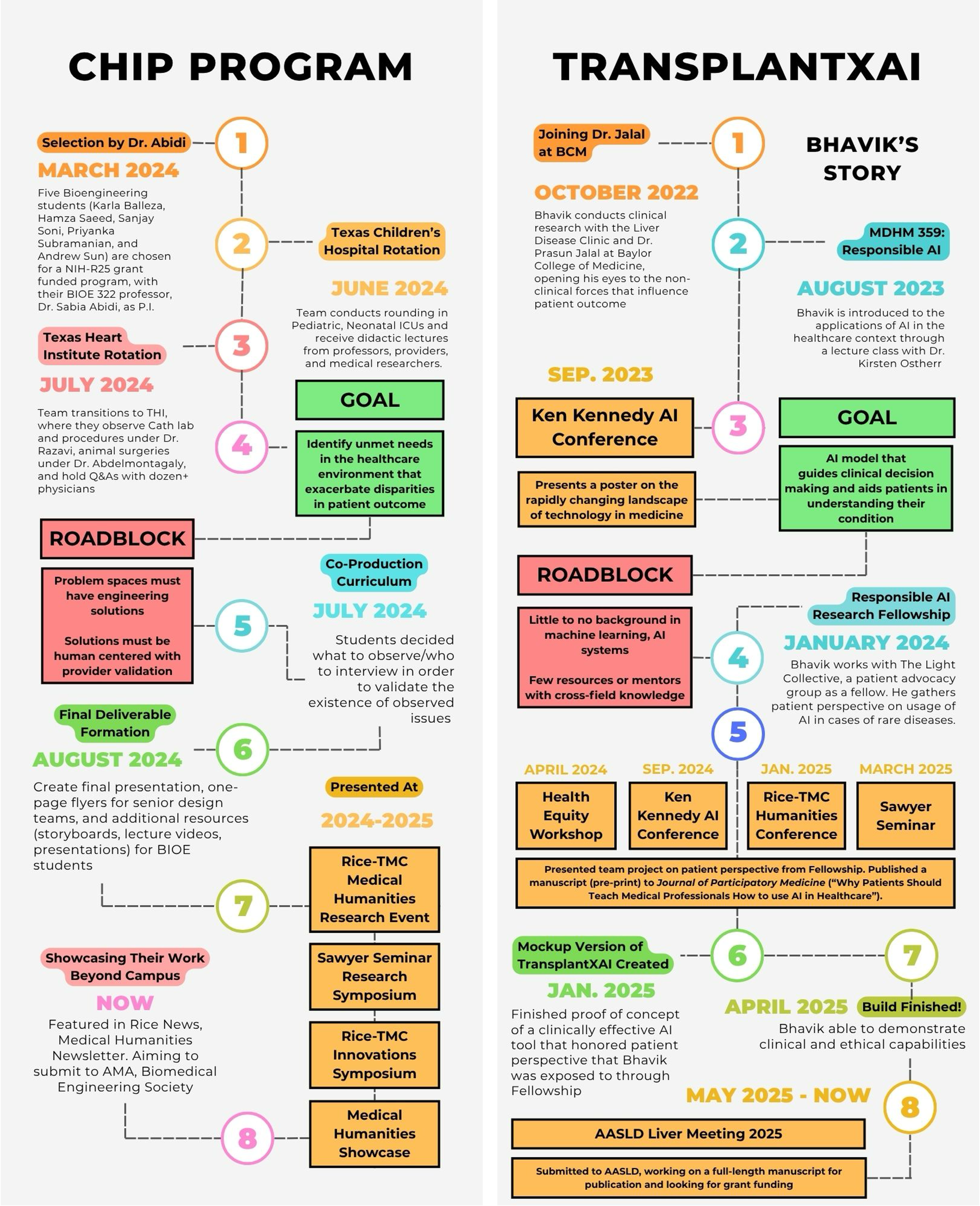
Our students come to Rice for a multitude of reasons, one of the foremost being the professional opportunities presented to them not only on campus, but in the greater Houston area through the relationships we foster with our world-renowned collaborators. The extent to which students invest in and benefit from these relationships was on full display at the “Health Innovations in the Rice-TMC Ecosystem” event. The event consisted of a poster session and competition that featured student research from institutions across the TMC, and a symposium that highlighted the impactful and innovative research in global health outcomes conducted by TMC researchers and clinicians. Hosted by Rice’s Office for Educational and Research Initiatives for Collaborative Health (ENRICH), the program showcased cutting-edge achievements in the fields of neurology, oncology, AI healthcare applications, and health disparities. The conference, which sought to continue fostering the strategic partnerships that have made the TMC a hub for state-of-the-art healthcare and research, aimed to bridge the gap that exists between the laboratory and clinic spaces in such a way that sincerely improves patient outcomes.
By creating an environment so conducive to the exchange of institutional knowledge and cross-field collaboration, ENRICH not only showcased to our students where their work can end up, they illustrated to our TMC partners where a lot of the polished work they find on Rice student posters originate from. Here, we want to highlight two amazing posters that were presented at the symposium and tell you a little bit about how a project starts off as a seed in someone's mind and flourishes into groundbreaking, impactful work.
Clinical Immersion as a Catalyst for Equity-Driven Healthcare Innovations

Andrew Sun¹, Sanjay Soni¹, Hamza Saeed¹, Priyanka Subramanian¹, Karla Balleza¹, Sabia Abidi, PhD¹, Satid Thammasitboon, MD² ³, Khayri Shalhoub, MD² ³, Parag Jain, MD⁵, Medhi Razavi, MD² ⁴
¹ Rice University Department of Bioengineering
² Baylor College of Medicine
³ Texas Children’s Hospital
⁴ The Texas Heart Institute at Baylor St. Luke’s Medical Center
⁵ UT Southwestern
Introduction: Healthcare disparities can be amplified when medical devices are developed without adequate clinical insight. This clinical immersion program exposes bioengineering students to real-world clinical challenges, with the goal of identifying unmet needs that contribute to inequitable patient outcomes. By using direct clinical observation to inform engineering problem statements, the initiative inspires innovations that are both effective and accessible.
Materials & Methods: The program combined didactic lectures with a six‑week clinical observation period at Texas Children’s Hospital and the Texas Heart Institute. Participants observed physician rounds, engaged in interviews with physicians and healthcare specialists, and were given the freedom to explore medical facilities through a co-production curriculum. Complementary methods—including systematic literature reviews, mentor feedback, and the development of storyboards and educational videos—were employed to gain a comprehensive understanding of clinical challenges and potential biases in device design.
Results: Immersive inquiry revealed three critical problem spaces. In pediatric tracheostomy care, significant caregiver stress during airway emergencies contributed to a 17% readmission rate and high associated costs. In peritoneal dialysis, the complexity of maintaining aseptic technique was identified as a barrier, particularly for low-resource and non–English-speaking patients. Additionally, pediatric hemodynamic monitoring, which relies on invasive procedures, was highlighted as a prime area for developing noninvasive, bioimpedance-based solutions. Solutions for the first two problems are currently being developed in the Rice Bioengineering senior capstone program. The program also produced educational videos that promote equitable design practices based on the clinical observations. These videos are now integrated into the Rice BIOE curriculum to further promote accessible design.
Conclusions: Direct clinical engagement equips future innovators with the human-centered perspective essential for sustainable, equitable medical device development. By identifying actionable clinical challenges early, this program lays the groundwork for solutions that reduce healthcare disparities and foster improved patient outcomes across diverse settings.
TransplantXAI: An Explainable AI/ML Model for Predicting Patient Survival Following Liver Transplantation

Bhavik Tadigotla
Rice University
Baylor College of Medicine
Background and Aim: Accurate post-transplant mortality prediction is critical for early intervention, patient counseling, and resource allocation. Yet risk scores often exclude sociodemographic factors and rely on static thresholds, limiting transparency and individualized risk interpretation. Our aim was to develop an explainable machine learning model (ML), trained on clinical and sociodemographic features, to predict recipient survival 90 days post-liver transplant.
Methods: TransplantXAI is a supervised ML model built on a cohort of 42,384 recipients from the United Network for Organ Sharing (UNOS). It uses 13 recipient clinical features identified as significant predictors of survival in the Survival Outcomes Following Liver Transplant (SOFT) score, and 3 recipient sociodemographic features: sex, race/ethnicity, and region. The cohort was split 70/30 (training/testing), with 5-fold cross-validation in the training set to optimize model performance. For model explainability, we used SHapley Additive exPlanations (SHAP) to generate global and individual-level feature contributions, clarifying each variable's influence on survival.
Results: With an AUC of 0.7045, TransplantXAI outperformed MELD and matched other ML models predicting 90 day survival post-liver transplant. SHAP analysis found functional status at transplant, prior malignancy, and MELD as the top 3 drivers influencing model predictions. TransplantXAI also revealed non-clinical disparities in survival within our cohort. Specifically, male sex correlated with positive SHAP values (indicating a contribution to improved survival), while female sex correlated with negative SHAP values (indicating a contribution to poorer outcomes). In race/ethnicity, White recipients had positive SHAP values, while all other groups (Black, Multiracial, Hispanic, Pacific Islander, Asian, and American Indian) had negative SHAP values. Geographic disparities were also evident: UNOS regions 2, 3, and 5 had positive SHAP values, while all others had negative values.
Conclusion: Our explainable ML model enables actionable opportunities for intervention by identifying patient-specific risk drivers. In revealing non-clinical disparities, TransplantXAI enables clinicians to tailor care plans—such as prioritizing size-matched donor livers for female recipients, or addressing language and community health barriers. By merging clinical and sociodemographic insights, TransplantXAI sets a precedent for transparent and equity-aware tools in transplant hepatology.