
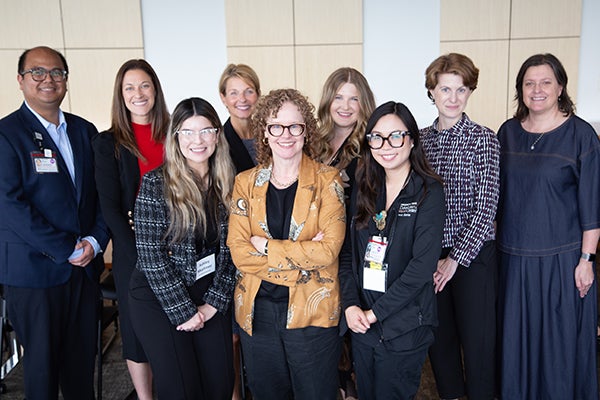
Pictured from left to right: (back) Kevin Lim (UT MD Anderson), Brittany Kruse (UT MD Anderson), Sadie Rau (UT MD Anderson), Mikela Pettigrew (UT MD Anderson), Matty Hemming (Rice), Kim Slusser (UT MD Anderson); (front) Ashley Martinez (UT MD Anderson), Kirsten Ostherr (Rice), Julia Nguyen (UT MD Anderson)
Photo credit: Donald Soward, D2 Studios
On April 20th, Rice students and Medical Humanities faculty convened with nurses from The University of Texas MD Anderson Cancer Center for the first Nursing and Narrative Showcase. The showcase included presentations by students in the Nursing and Narrative course (MDHM 320) taught by Dr. Matty Hemming, Janice G. Doty Lecturer in Medical Humanities, and a panel discussion featuring the nurses interviewed for the students’ oral history projects.
The event marked the culmination of a semester-long collaboration between Rice Medical Humanities and the UT MD Anderson Meyers Institute for Oncology Nursing, which was first sparked when Rice Alumna and UT MD Anderson Director, COO Project Management Office, Kate Gunn Pagel connected Rice Medical Humanities with the leaders of the Meyers Institute. The Meyers Institute, led by Dr. Sadie Rau, is a first-of-its-kind driving force supporting the comprehensive elevation of nursing practice as a key tool in the innovation of cancer care. Since then, the collaboration has reflected a joint institutional commitment to storytelling, connection, the medical humanities, and the nursing profession.
Rice Associate Paula Gilmer DesRoches, a healthcare professional, nurse practitioner, and administrator, gave opening remarks for the event. Recognized for her leadership in occupational health, Gilmer DesRoches discussed the strategic importance of highlighting nursing perspectives that are often overlooked despite their significant role in patient experiences.
The Nursing and Narrative course examines cultural and historical narratives of nursing in the US through several avenues, including guest speaker visits, oral history interviews, trips to local archives, and in-class discussions. Students reflected on questions such as, “What are the dominant depictions of nursing’s meaning, and what do they get right or wrong?” and “How does nursing’s ethic of care intersect with the Medical Humanities?”
Dr. Hemming shared with us why having a course like Nursing and Narrative is important: “What is so special about this course is that it was produced out of a collaboration with nurses working locally in order to improve the experiences of nurses and patient experience in Houston. Students in the class were able to directly contribute to this effort by producing oral histories that will be of value to current and future generations of nurses.
On a personal level, most of the students in the course plan on working in health care in some capacity, many as physicians. This course provided a valuable opportunity for all of us to reflect on our internalized stories about the different roles in health care, and to educate ourselves about the complexity of nursing, which is so often either ignored or idealized.”
She also commented on the value of the showcase, writing, “It was so meaningful for the students to see the value that their coursework on nursing held for the many nurses who attended. The room was buzzing with conversation and brought so many of the topics that we had been discussing in class to life in powerful and unexpected ways.”
The presentations gave students an opportunity to share insights from the course and their experiential learning. They focused on separate, yet intertwined aspects of nursing history: Care, Expertise, and Creating Nursing History.
- Care, presented by Sophia Cheng, Sarah Choi, and Cindy Ren, discussed how care is central to nursing and the historical complexities of this link. The presenters emphasized the dilemma of caring and the obligation to overcome societal barriers to care, the devaluation of nursing, and the evolution of care.
- Expertise, presented by Emmanuela Akwar and Alysia Palomo, detailed assertions and challenges to nursing and midwifery expertise, including how they are perceived as gendered professions. Their presentation also centered on advanced practice nursing, which recognizes nursing as a distinct academic discipline with opportunities for novel scientific research.
- In Creating Nursing History, student presenters Lahari Chennupati, Kai Hyodo, and Nidhi Rao presented critical reflections on nursing history methodology, significant nurses in history, and archival research. The presentation highlighted the importance of archival research and oral histories in studying the evolution of nursing practices and preserving the personal experiences of nurses and patients.
Following the presentations, nurses Julia Nguyen, Dr. Ashley Martinez, Kevin Lim, and Mikaela Pettigrew shared their experiences with audience members during a student-moderated panel discussion.
Chief Nurse Executive at UT MD Anderson, Dr. Kim Slusser, delivered closing remarks, commenting, “What we witnessed this afternoon was more than a showcase of student projects—it was a reminder of the many ways nursing shows up in healthcare and in people’s lives. Through these narratives, we experienced the history of nursing and explored where it will go next. We saw nurses as experts, clinicians, advocates, educators, leaders, and steady presences in moments that matter most.”
The oral histories collected by the students as part of the “Nursing and Narrative” course have been gifted to UT MD Anderson, becoming part of their institutional memory and nursing history. Future collaborations with the Meyers Institute include nurse-led research projects in partnership with Rice Medical Humanities students.
Thank you to UT MD Anderson, Sadie Rau, Kim Slusser, Javier Garza, Brittany Kruse, Brittany Bowers, and the Meyers Institute for Nursing Oncology for your insights, support, and partnership. Special thanks to Julia Nguyen, Ashley Martinez, Kevin Lim, Mikaela Pettigrew, Morgan Nestingen, and Dan Joshua Orencia for sharing their stories for the oral history project. Thank you to the following Rice faculty and staff who helped make this event possible: Matty Hemming, Fatima Bazan Mota, and Rebecca Russell.