
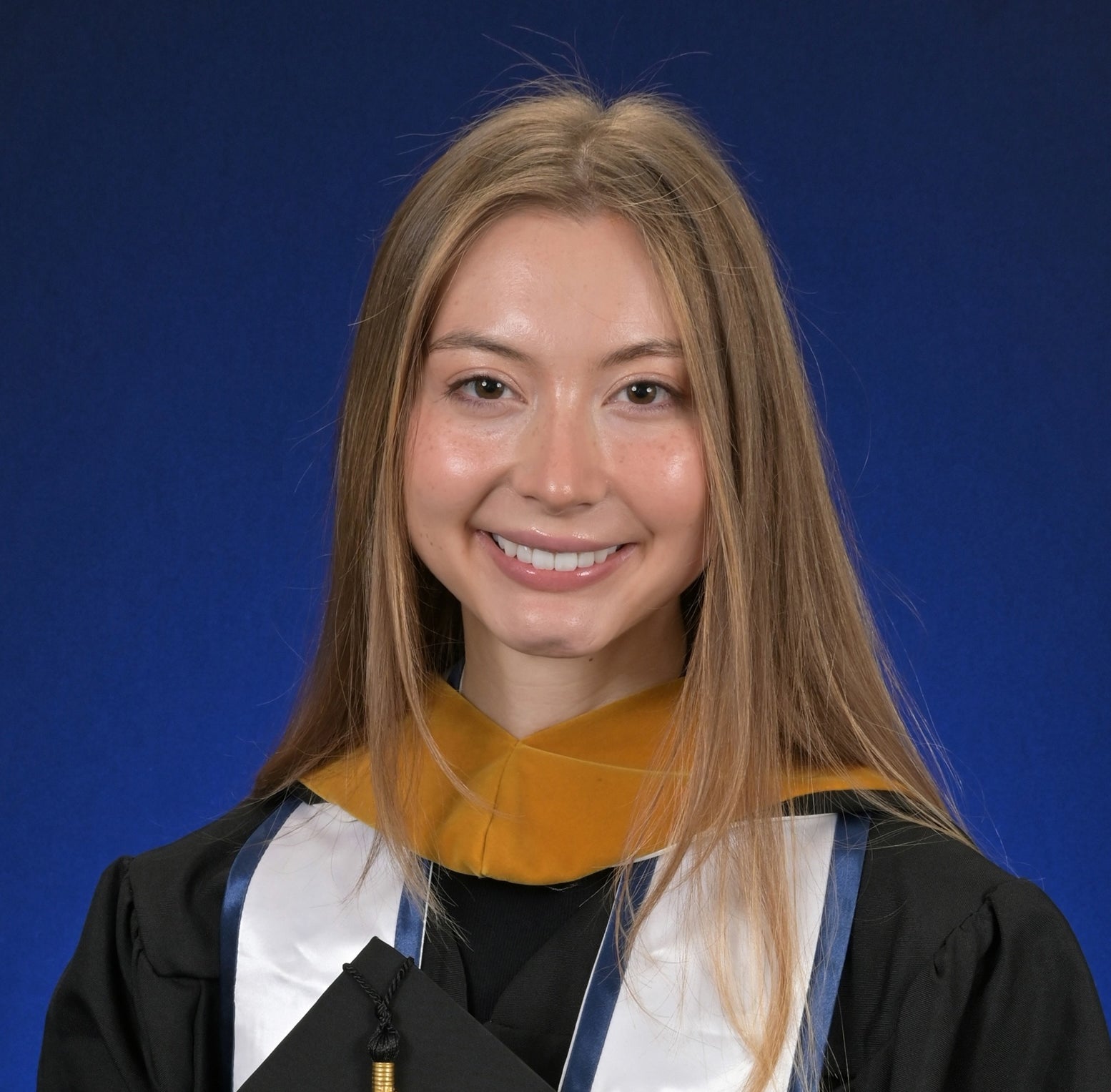
It is a challenge to list all the activities Isabella pursued while majoring in Health Sciences and minoring in Medical Humanities at Rice before graduating in May 2025. A Writing Consultant at the Center for Academic and Professional Communication, a volunteer for Rice Alliance, and a host of Princeton’s TigerLaunch Pitch Competition, Isabella was drawn to the humanistic aspect of health and medicine emphasized by the Medical Humanities Program. Her interest in medical technology ethics and policy led to her placement with a year-long medical humanities practicum project, where she joined a research team at Baylor College of Medicine’s Center for Medical Ethics and Health Policy focused on the ethical dimensions of integrating AI and machine learning into decision aids. The University of Pennsylvania Carey Law School, an institution that emphases an interdisciplinary legal education, was a perfect fit for Isabella’s next chapter, because she plans to pursue a corporate transactional legal career with a focus in the life science and healthcare industries, as well as engage in pro bono projects in public health policy. As Isabella transitions into this next stage of her career development, we talked with her about her experience as part of the Medical Humanities Program.
What are you working on in your first year post-Rice?
I am a first-year J.D. Candidate at the University of Pennsylvania Carey Law School, where I am a Silverman Scholar. At Penn Carey, I am a 1L Representative for the Health Law & Policy Association and the Capital Markets Association.
What was your chosen field of study at Rice? What campus activities did you participate in that you were particularly fond of?
I majored in Health Sciences and minored in Medical Humanities. One of my most meaningful activities at Rice was working as a Writing Consultant at the Center for Academic and Professional Communication (CAPC). I was able to channel my passion for writing in this position, and I enjoyed getting to work with students on a wide range of academic assignments and graduate school applications. Working one-on-one with them, asking them questions to understand their needs, and offering solutions contributed to my interest in pursuing a legal career. Most significantly, I loved getting to meet new Rice students each week! I also valued my involvement with the Rice Alliance for Technology and Entrepreneurship. I volunteered at several Rice Alliance events, including the Rice Business Plan Competition and Venture Capital Investment Competition. In February 2025, I collaborated with Princeton University’s TigerLaunch Competition to host a regional TigerLaunch Pitch Competition on Rice campus! These events fueled my interest in startups and venture capital and contributed to my interest in corporate law.
How did you use what you learned from the Medical Humanities program at Rice in advancing your career development?
The Medical Humanities program played a significant role in my switch from premed to prelaw and confirmed that my interest in health lies at the global and public health policy level. Overall, I thoroughly enjoyed the humanistic and interdisciplinary aspects of health and medicine that the program emphasizes. I began my time at Rice as a premed student in the Rice-Baylor Medical Scholars program and took the pre-med requisite courses. While I enjoyed the premed STEM courses, I realized I was most enthusiastic about the elective Medical Humanities courses that featured health policy components and broader societal implications. Many of the Medical Humanities courses focused on health policies that can help alleviate health inequities. For example, BIOS 447: Experimental Biology and Medicine, an elective for the medical humanities minor, investigated emerging biotechnologies and was pivotal in shaping my interests. In a class filled with pre-medical or pre-PhD students, I eagerly took on the role of researching, writing, and presenting the ethical and legal implications of such technologies.
After this class, to further my interest in medical technology ethics and policy, I applied and was selected to join a research team at the Baylor College of Medicine Center for Medical Ethics and Health Policy for my Medical Humanities minor practicum. The research team, led by Dr. Jennifer Blumenthal-Barby, was focused on the ethics of using a decision aid to improve the patient decision-making process for left ventricular assist device (LVAD) surgery. The team was also investigating the integration of artificial intelligence and machine learning into the decision aid. I thoroughly enjoyed the interdisciplinary nature of the bioethics research. The MedHum practicum contributed to my interest in bioethics. It was also a contributing factor for my choice to attend Penn Carey for law school, since Penn has many interdisciplinary programs, including one in bioethics! I now hope to provide impactful change in the health and medical technology fields through policy and legal advocacy.
Any final thoughts on the program?
Overall, I am immensely grateful for the MedHum program, and I strongly believe that students can tailor the program to fit their interests and post-grad plans. While many students in MedHum are premed, I think the program can benefit many different post-graduate paths! I’m excited to bring unique perspectives I’ve developed through the Medical Humanities program to law school discussions!