
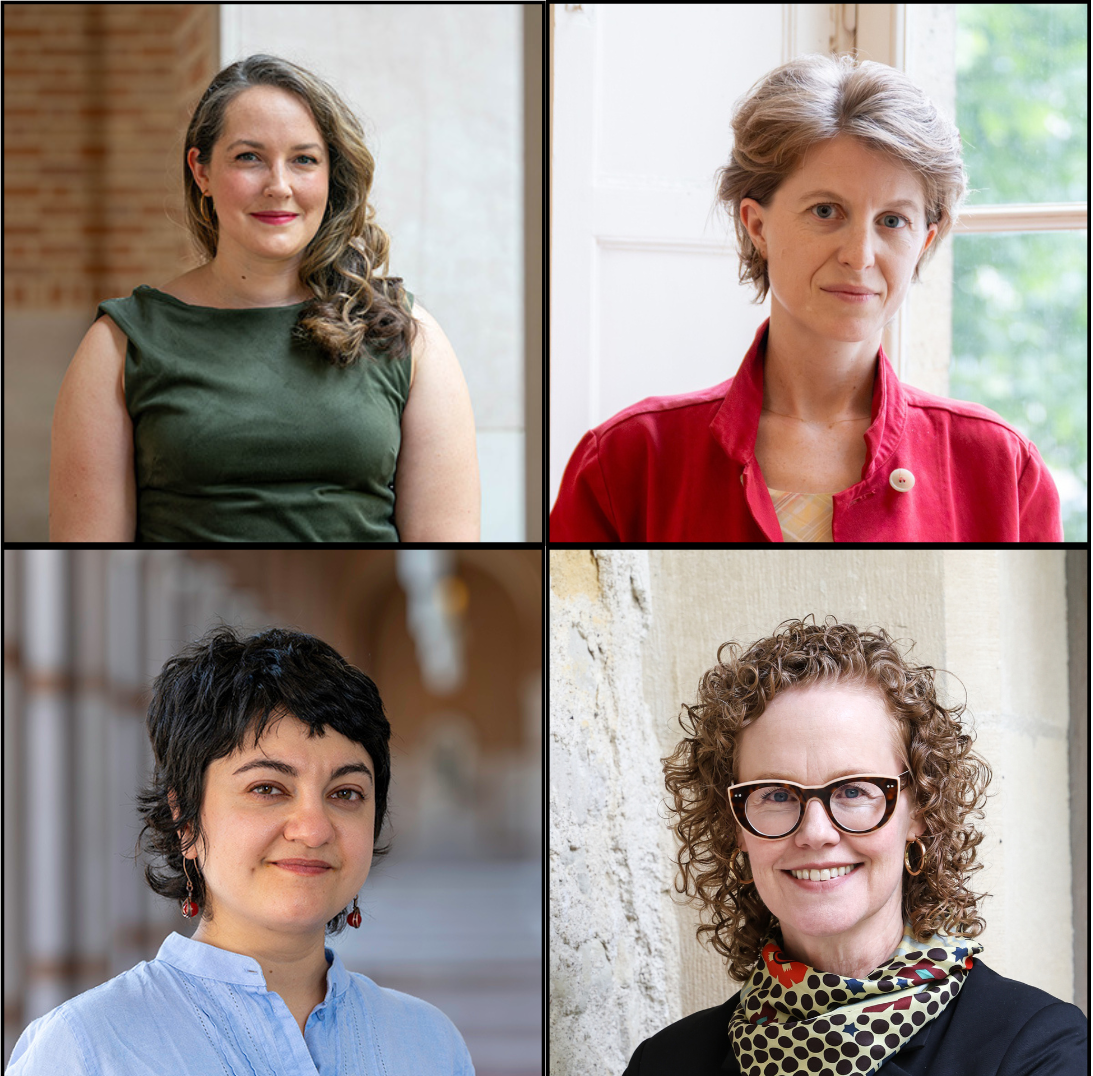
Photos (left to right, top to bottom): Katherine Shwetz, Matty Hemming, Samin Rashidbeigi, Kirsten Ostherr
From April 8-11, 2026, Rice Medical Humanities faculty members Katherine Shwetz, Matty Hemming, and Kirsten Ostherr, and postdoctoral fellow Samin Rashidbeigi attended the Health Humanities Consortium, an international convention that promotes health humanities scholarship, education, and practices. The Medical Humanities Program and Medical Humanities Research Institute are proud sponsors of the Health Humanities Consortium.
Below are highlights from their contributions in the most recent conference.
Dr. Katherine Shwetz, Lecturer in Medical Humanities and MHRI Research Scientist
Justice, Equity, Diversity, Inclusion, and Belonging Committee
Paper Presentation: “MAHA’S Narrative Estrangement”
Dr. Schwetz presented on how prominent Make America Healthy Again (MAHA) figures use the process of “estrangement” to defamiliarize everyday experience to make ordinary things seem threatening. In this way, narrative worlds are created in which the individual subject is systematically alienated from and imperiled by everyday objects. The result of this is hypervigilance, heightened individualism, and an obsession with control. Shwetz notes that the power of art to re-enchant is not only available to those working towards more compassionate and person-focused healthcare. She encourages us to reconsider how we characterize the function of art and literature in this field, balancing appreciation with critical assessment.
Dr. Matty Hemming, Janice G. Doty Lecturer in Medical Humanities
Paper Presentation: "Medicine’s Literature, Literature’s Medicine: Towards Structural and Historical Reading"
Dr. Hemming’s paper explored debates about the contributions of literary knowledge to healthcare. She challenges an assumption in the health humanities that the primary purpose of teaching literature to healthcare professionals is to improve empathetic capacities. Instead, she argues that literary scholars should ambitiously assert the epistemological, rather than emotional, value of literature to health and medicine.
Dr. Samin Rashidbeigi, 2024-2026 Sawyer Seminar Postdoctoral Fellow. Current position: Junior Research Fellow, Crown Center for Middle East Studies, Brandeis University
Paper Presentation: “Independent Cinema and Promoting Voluntary Blood Donation in Iran”
Dr. Rashidbeigi’s presentation investigated the relationship between independent critical cinema and its capacity to produce real social change in public health. Specifically, she focused on the role of Dariush Mehrjuyi’s feature film Dāyereh-ye Minā (The Cycle, 1975) in the institutional history of blood transfusion in Iran. She traced the process in which a film banned by the state for exposing an uncomfortable social reality was subsequently celebrated and instrumentalized by national blood transfusion organizations. This raises a broader question about what happens to the power of independent cinema once it is claimed by the state, and what implications it may have for the future of public health.
Dr. Kirsten Ostherr, Gladys Louise Fox Professor of English and Creative Writing
Roundtable Session: “Then as Now”: Historicist Health Humanities Approaches to Contemporary Healthcare Challenges
Roundtable Chair: Rachel Bracken (Dr. Ostherr’s former PhD student at Rice; current position: Associate Professor of Family and Community Medicine, NEOMED)
Dr. Ostherr contextualized the rapid adoption of health AI, especially large language models (LLMs) in relation to three intersecting histories: the history of adoption of new and unproven medical technologies in health care settings (e.g. first-generation surgical robots such as DaVinci), the history of health system efforts to treat patients as data sets (e.g. early electronic medical record systems at the NIH in the 1960s), and the recent history of “disruptive” information and communication technologies in healthcare (e.g. the internet, social media, mobile apps). By tracing each of these throughlines to the current health AI frenzy, she will presented critical perspectives that can help us reframe the current moment and identify opportunities for health humanists to intervene and educate.
Panel: AI for Health Justice
Health humanities scholars Kirsten Ostherr, Kim Gallon (Brown University), and Bernice Hausman (Pennsylvania State University) presented a panel discussion focused on AI in healthcare within the broader frame of health justice. Health humanities offers robust disciplinary and interdisciplinary frames within which to develop critical attitudes toward healthcare AI. While technical education in AI tools is certainly necessary, given that the vast majority of healthcare practitioners will be users of AI tools but not creators of them, there is a need to design educational opportunities that focus on understanding how social structures are implicated in AI tool creation and implementation. Health humanities frameworks are also attuned to address ethical and social justice issues in healthcare AI implementation. The panelists offered insight into existing projects and practical guidance on designing humanities research projects on health AI, public AI tools, courses, and curricula that address AI for Health Justice.