
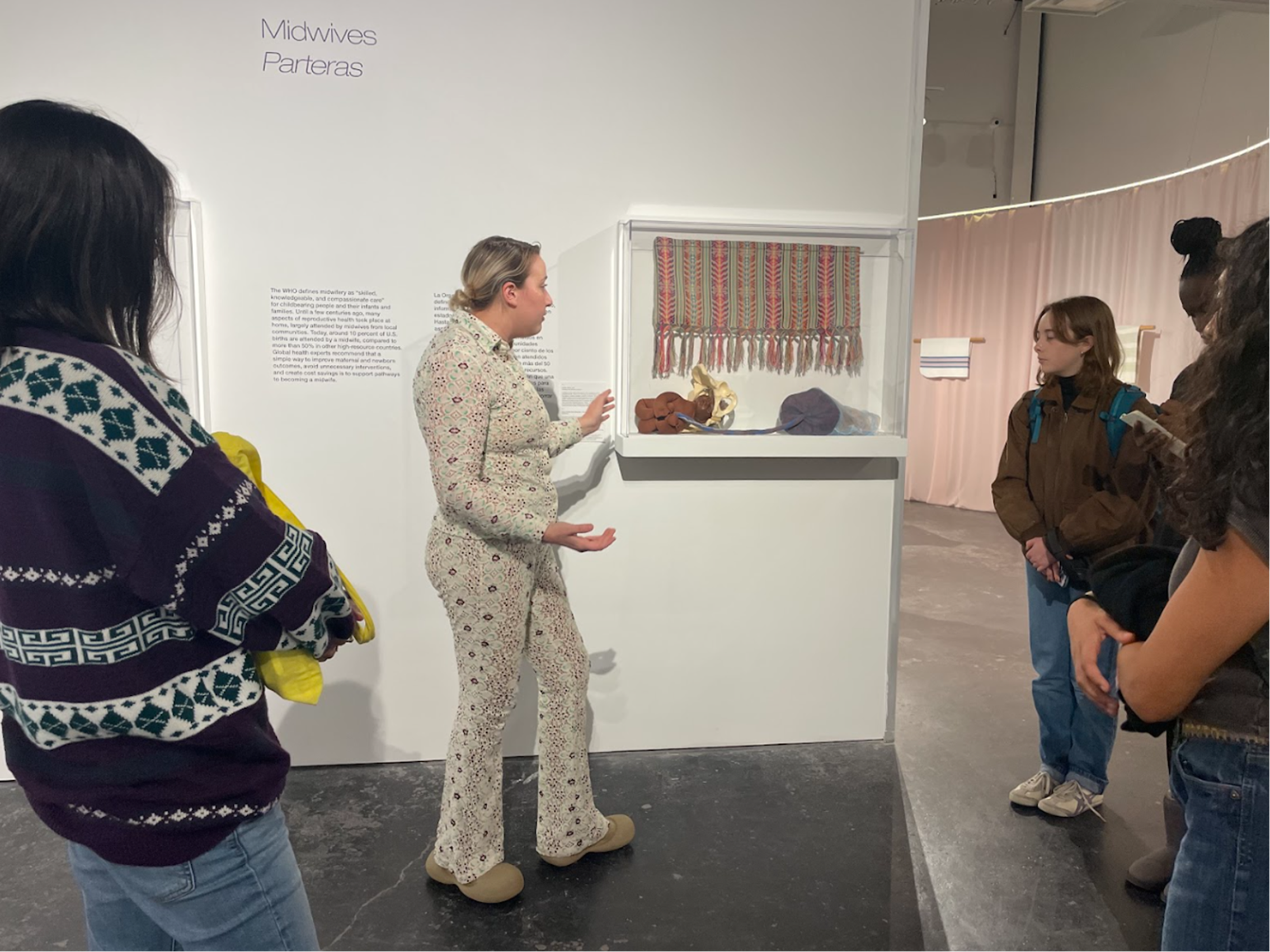
Photo: HCCC Exhibitions Director Sarah Darro gives students a tour of the exhibition
On a blustery November day during the Fall 2024 semester, students in Dr. Matty Hemming’s course “Narratives of Reproduction” left campus to take their class at the Houston Center for Contemporary Craft. They were there to see a new exhibition, Designing Motherhood, curated by Sarah Darro (Exhibitions Director at HCCC) in collaboration with the Designing Motherhood curatorial team, Amber Winick and Michelle Fisher. The exhibition featured objects ranging from artworks created by and about artist parents to the medical tools used in reproductive healthcare, with many objects blurring the boundary between art and technology. Darro, who generously gave the class a tour of the exhibition, writes that ““HCCC’s presentation of Designing Motherhood draws out the intertwined properties of labor, care, embedded history, material intelligence, and intergenerational knowledge shared by craft and parenthood, ultimately asserting such reproductive experiences as forms of craft themselves” (Designing Motherhood – Houston Center for Contemporary Craft).
With its capacious understanding of the practice, craft, and politics of parenthood, HCCC’s Designing Motherhood engaged with many of the areas of reproduction– birth, birth control, abortion, midwifery, domestic labor - considered in Dr. Hemming’s course. In “Narratives of Reproduction,” students asked questions such as, what does it look like to read novels and films via a reproductive justice framework? What can fictional texts and films show us about reproductive experiences, politics, and histories? The HCCC visit built on classroom discussions, asking students to think about the power of visual and material objects to narrate the complexity of reproduction and motherhood, and giving them the chance to see in real life some of the objects (such as the Sims speculum, a technology with a deeply racist origin story) studied in class.
One student, Joselyn Lwigale, was so inspired by the exhibition that she decided to make it the focus of her final project. Her review essay focused on a few especially powerful objects, such as “Abortion Seed Library” (2022) by Dallas-based artist Cynthia Mulcahy.
As Lwigale writes, “The 2022 piece is a pink box of 48 cork-sealed glass tubes filled with different plants, seeds, and herbs. The plants are all abortifacients, which ‘have a long history in [various] world societies’ recognized in ‘8th-century Sanskrit texts…early rabbinical writings…and early American enslaved women, midwives, and apothecarists’ (Mulcahy, 2022). Additionally, she states that some of the collected seeds come from Nirvana lyrics. It instantly took [Lwigale] back to one of the group’s songs, Pennyroyal Tea, its title referring to the abortifacient plant. The variety of seeds show how people have always crafted ways to receive the care they need, using the resources available to them. It is also particularly poignant considering the abortion landscape in Texas today. This piece shows how abortion has existed as long as humans have been giving birth and is just another form of reproductive health care.”