
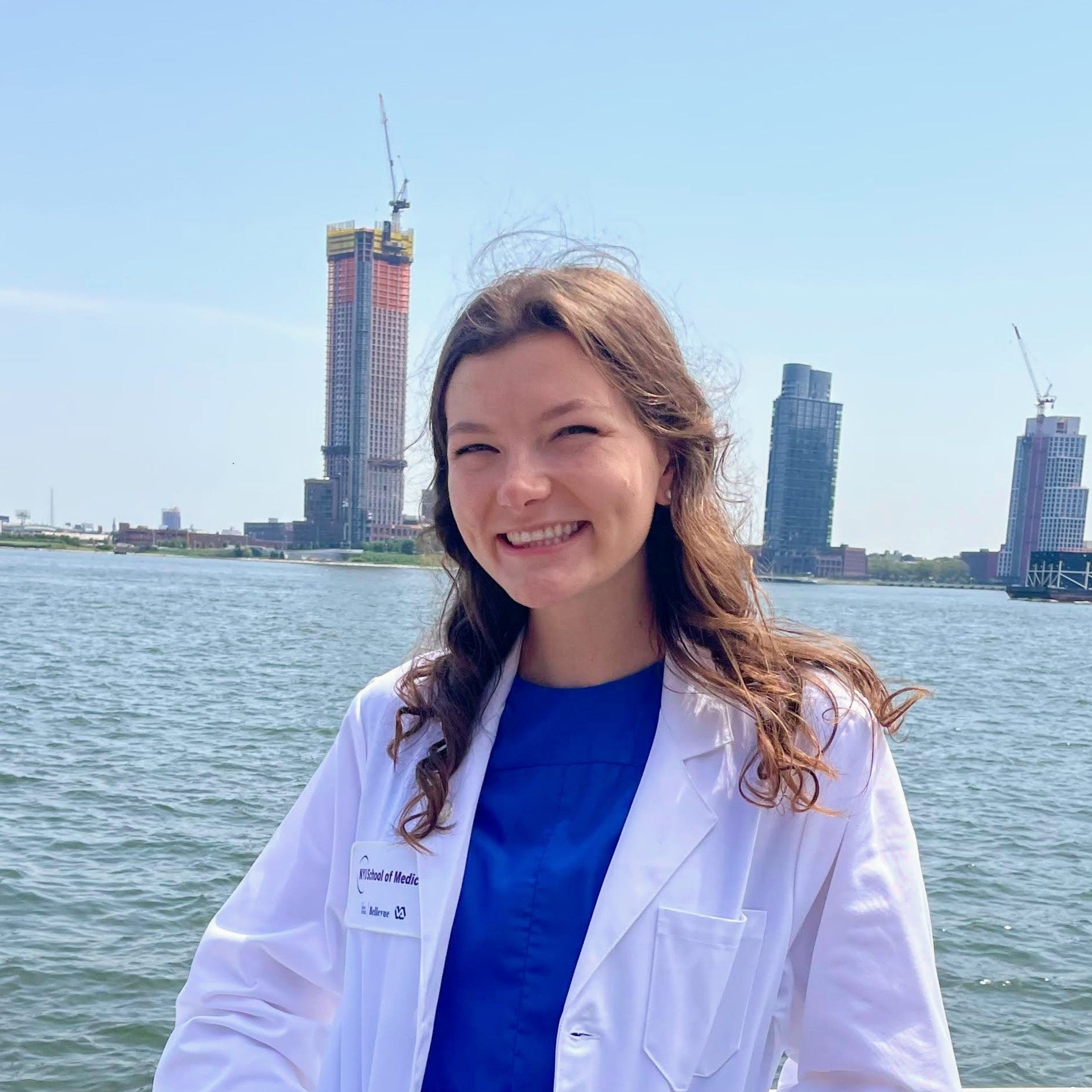
You graduated from Rice in May 2021. What do you miss most?
It’s hard to choose! I miss the beautiful campus, my friends, and exploring different interests and using different parts of my brain through a varied class schedule. I recently had a strong craving for a Nutty Bee from Coffeehouse, though, so maybe that’s my truest answer.
What have you been up to since then?
Since graduating, I have been in medical school at NYU in New York City. It has kept me busy between the classroom and the hospital, but I have also been able to explore the city and travel both in the northeast and abroad. I am now in my fourth year and beginning the application process for internal medicine residency.
What was your favorite aspect of the minor in medical humanities?
My favorite aspect of the medical humanities minor was the variety of classes I got to take. No two classes were alike. One thing I’ve realized is that while I’ve forgotten most of the organic chemistry reactions that I spent so many hours studying, I remember with such clarity the discussions that took place in my medical humanities classes.
You also did quite a bit of research in medical humanities at Rice. Can you tell us a little about that?
During my senior year, I researched the history of two hospitals in Houston: Jefferson Davis (now defunct) and Ben Taub Hospital. I felt as though I were uncovering a mystery, and it kept getting more interesting the deeper I dove. One of my favorite parts of the project was looking through old documents in the medical center archives. I wrote two encyclopedia articles, which was challenging because I had so much to say in a limited format. I also wrote a creative piece about the process of research and writing which allowed me expand on the experience. It was my favorite project in college.
How has your coursework and research in medical humanities influenced your approach to your medical education?
There is so much information to learn in medical school that it is easy to lose sight of where it came from or how it is being applied. Medical humanities places all the knowledge into context for me. It’s also given me a healthy skepticism of the idea of objectivity, because, as I learned in my med hum classes, there’s always some hidden subjectivity; behind every x-ray is someone deciding what to image.
In the medical humanities concentration at NYU, what is one of the most important things you’ve learned?
I think one of my key takeaways has been seeing how so many people incorporate medical humanities into their careers. I thought medical humanities might just be a side interest, but I’ve realized that so many physicians work on ethics, journalism, creative writing, history, and more. As far as my favorite medical history fun fact I’ve learned, it’s probably about President Grover Cleveland’s secret surgery on a yacht. He had a tumor removed from his mouth, and no one knew about it for years. It’s a bizarre, delightful story.
How do you envision your career?
The next step for me is 3 years of internal medicine residency. I’m not quite sure what I’ll pursue after that. I really like the field of infectious diseases, so I will most likely end up there, but I’m open to any subspecialty or primary care. I do know that regardless of the specific field, I want to be involved in medical education.
Do you have any words of wisdom for Rice premed students?
Taking the MCAT and applying to medical school are such daunting tasks, and they are just the start of the long process of becoming a physician. The best advice I received was the simplest — enjoy every step of the way. I’ve realized this requires both having a well-rounded life outside of school as well as finding meaning in the work itself. I expected to feel as though I just needed to survive the 4 years of med school, but it has brought so many incredible opportunities and experiences, both inside the hospital and far away from it. There’s so much to look forward to.